

A mortgage rate buydown lowers your interest rate by paying money upfront at closing. The money may come from you, the seller, the builder, or another permitted party. How does a mortgage rate buydown work in practical terms? A lender applies that upfront payment to reduce either your rate for the life of the loan or your payment for the first few years.
Think of a mortgage rate buydown as paying some of your financing costs upfront in exchange for lower monthly payments. Sometimes you pay for it yourself, and other times the seller or builder covers the cost as part of the deal.
That can make a new home more affordable during a period when cash flow is tight. But a buydown is not automatically the right move. The value depends on who is paying, how long you expect to keep the mortgage, the loan program, and whether a lower rate is available without giving up other priorities such as down payment funds or reserves.
The two types of mortgage rate buydowns
Mortgage buydowns generally fall into two categories: permanent buydowns and temporary buydowns. Both reduce the borrower’s cost, but they work very differently.
A permanent buydown lowers the rate for the full loan term
With a permanent buydown, the borrower pays discount points at closing. One discount point generally equals 1% of the loan amount, although the amount of rate reduction a point creates varies by market conditions, loan type, credit profile, property type, and lender guidelines.
For example, on a $400,000 loan, one point costs $4,000. Paying that amount may reduce the interest rate, but there is no universal rule that says one point always cuts the rate by a certain percentage. Your lender should show the actual cost and payment difference before you decide.
The main benefit is consistency. Your principal and interest payment remains lower for the life of a fixed-rate mortgage. The trade-off is the larger upfront cost. You need to consider how long it will take for monthly savings to repay what you spent at closing.
A temporary buydown lowers payments for a limited period
A temporary buydown reduces your payment for a set introductory period, usually one to three years. The note rate on the mortgage does not change. Instead, funds are placed in a buydown account and used to cover the difference between your reduced payment and the full payment due under the note.
A 2-1 buydown is a common example. Your payment is calculated as if your rate were 2% lower during year one and 1% lower during year two. Beginning in year three, you make the full payment based on the permanent note rate.
A 3-2-1 buydown follows the same idea over three years: 3% below the note rate in year one, 2% below in year two, 1% below in year three, and the full note rate starting in year four. Availability varies. Program rules, seller-concession limits, and lender guidelines determine whether a temporary buydown is allowed.
Try our Buydown Calculator to simulate different scenarios.
How a 2-1 mortgage rate buydown works
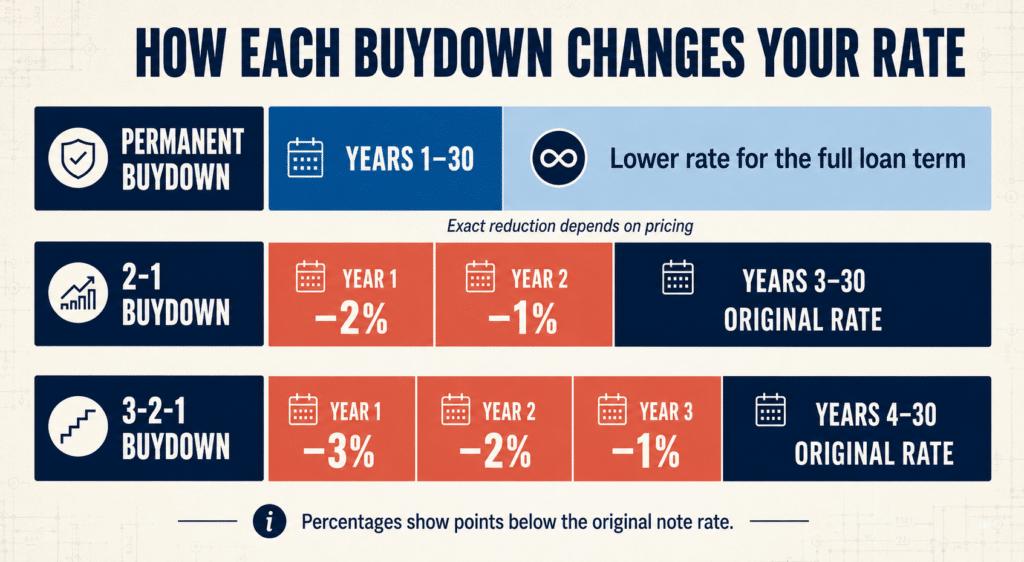
Suppose your permanent note rate is 6.5% on a 30-year fixed mortgage. With a 2-1 buydown, the payment is calculated at 4.5% in the first year, 5.5% in the second year, and 6.5% from the third year forward. Your loan balance and the note rate are still based on the original loan terms.
The important detail is that the lender generally qualifies you using the full note rate, not the reduced introductory payment. That helps prevent a borrower from qualifying for a home payment they may not be able to afford once the buydown ends. Qualification rules can differ by loan program and lender, so talk with one of our licensed loan officers about the guidelines that apply to your file.
The party funding the buydown pays the total subsidy into an account at closing. Each month, the servicer applies part of that money toward the payment difference. It is not a separate loan that you repay later, and it is not an adjustable-rate mortgage.
Who can pay for a mortgage buydown?
The borrower can pay for a permanent or temporary buydown, subject to program rules. In a purchase transaction, a seller may also contribute funds toward eligible closing costs and buydowns. Builders sometimes offer temporary buydowns as an incentive on newly built homes.
Seller-paid buydowns can be especially useful when a buyer would rather receive a payment reduction than a price cut. A lower purchase price can help, but it may only change the monthly payment modestly. A seller credit applied to a temporary buydown may create more noticeable payment relief during the first one to three years.
There are limits. Conventional, FHA, VA, and other programs have rules around interested-party contributions, and those limits may depend on the down payment, occupancy, property type, and loan type. Funds cannot simply be applied in any way a buyer chooses. The purchase contract, loan estimate, and closing disclosure should clearly show how the credit is being used.
When a buydown may make sense
A buydown may be worth considering if a seller or builder is covering most or all of the cost. It may also fit a borrower who expects a reliable income increase, such as a physician finishing residency, a buyer returning to work after a planned leave, or a household with a documented promotion ahead.
For a permanent buydown, the key calculation is the break-even period. Divide the upfront cost by the estimated monthly savings. If paying $4,000 reduces your payment by $80 per month, the simple break-even point is about 50 months. If you sell, refinance, or pay off the mortgage before then, you may not recover the cost through payment savings.
That calculation is useful, but it is not the only factor. A lower payment can improve monthly breathing room, which may matter more than a strict break-even timeline for some borrowers. It also depends on whether spending cash on points would leave you short on reserves, repairs, moving costs, or your down payment.
When a mortgage rate buydown may not be the best choice
A temporary buydown deserves careful attention if you are using it to qualify emotionally rather than financially. You should be comfortable with the full payment after the subsidy ends. Do not assume refinancing will be available by then. Future rates, home values, income, credit, and refinance guidelines are unknown.
A permanent buydown may be less appealing if you expect to move or refinance soon, or if the monthly savings are small relative to the cash required at closing. In some cases, keeping the funds for a larger down payment, emergency reserves, or necessary home improvements may be more practical.
Buyers using down payment assistance should also ask how a buydown interacts with their specific program. Some assistance programs may allow certain closing-cost uses, while others have restrictions. The same applies to FHA, VA, jumbo, and non-QM financing. Depending on credit, income, property type, and lender guidelines, the available options can look very different.
Questions to ask before accepting a buydown
Ask for the full payment at the note rate, not only the attractive first-year payment. Confirm who is paying the buydown, the exact dollar amount being contributed, and whether any unused temporary buydown funds would be handled if you sell or refinance early.
You should also compare the buydown against alternatives: a seller credit toward other closing costs, a lower sales price, a permanent rate reduction, or simply taking the loan with no points. Review the loan estimate closely so you can see the interest rate, lender credits or points, cash to close, and projected payments side by side.
A mortgage broker can help compare eligible structures from multiple wholesale lending partners rather than limiting the conversation to one bank’s offerings. At Price Mortgage, the goal is to make the payment change, upfront cost, and trade-offs clear before you commit to a contract.
Common questions about mortgage buydowns
Does a temporary buydown change my mortgage balance?
No. Your loan amount and amortization are based on the original mortgage terms. The buydown account supplements your payment for a limited time; it does not reduce the principal balance faster.
Can I refinance after using a buydown?
You may be able to refinance if you qualify at that time. However, refinancing depends on your income, credit, equity, loan program, and market conditions. A refinance should not be assumed as the plan for handling a future payment increase.
Is a buydown the same as an adjustable-rate mortgage?
No. A temporary buydown on a fixed-rate loan leaves the note rate fixed. An adjustable-rate mortgage has a rate that can change under the terms of the loan after its initial fixed period.
Before choosing a buydown, focus on the payment you can comfortably manage after every subsidy ends. A clear comparison of the full payment, upfront costs, and your likely time in the home will usually point you toward the more practical choice.
